Place matters
There are few places better than Richmond, Virginia to study Civil War history.
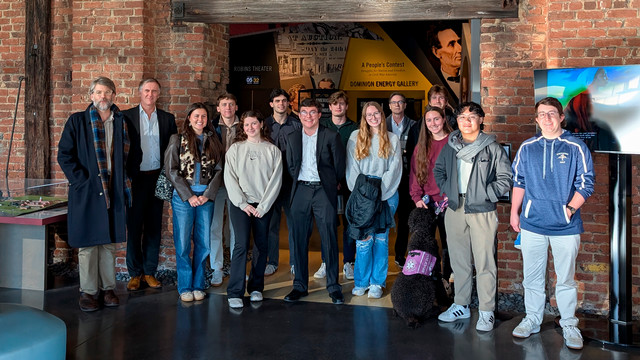
Students in history professor James Broomall’s Civil War and Memory class learned why during a series of study trips to the Virginia Museum of History & Culture (VMHC) and the American Civil War Museum (ACWM) supported by Course Support Grants from the Bonner Center for Civic Engagement.
"I was really invested in having the students think about public representations of the Civil War - ways in which historic sites and museums are grappling with the legacies of the conflict," said Broomall, a widely published cultural historian of 19th-century America who specializes in the Civil War and Reconstruction era, Southern history, and material culture.
At the VMHC, library director James Brookes exposed the students to a series of documents from the museum’s vast collection.
"He created a large narrative arc with materials going back to the Civil War era but then all the way to the present day," Broomall said.
The class was fascinated by one Civil War era diary that had been transcribed in the 1940s by an individual seeking to romanticize the Confederacy, then more recently by a visiting scholar.
"There were major discrepancies between the transcriptions," Broomall said. "It was a tangible manifestation of how memory starts to change even historical documents."
Brookes then led the students to one of the museum’s exhibitions, Lost Cause: Myths, Monument, and Murals.
The Lost Cause was a widespread effort by former Confederates to justify and glorify the Confederacy, and the exhibition features Confederate Memorial Military Murals by Charles Hoffbauer, a Robert E. Lee statue by Edward Valentine, and other artifacts.
"James really wanted them to interrogate the seasons of the war and think about the different modes of presentation," Broomall said. "He also talked about how the physical space outside of the gallery had been altered, and how the museum is, as an institution, thinking much more expansively about its history and its relationship to the city. I think they benefited from that tremendously."
At the ACWM, the students explored the galleries in depth, then returned for a second study trip to engage in deeper conversations with president and CEO Rob Havers and director of collections and senior curator Robert Hancock.
"Professor Broomall identified that another visit would amplify the students’ learning," said Sarah Adams, CCE assistant director of community-engaged learning. "We were excited to accommodate the request."
Havers took nearly an hour out of his busy schedule to share about his critical role as a museum director, scholar, educator, and fundraiser, then Hancock highlighted pieces from their rich collection, including a recently acquired nineteenth-century daguerreotype.
The students were able to view the early photograph and the curator’s research folder, then discuss how it might be featured in an exhibition and what stories it might help to tell.
"I think the classroom is a very expansive concept," Broomall said. "Our core duty is to interrogate source materials and to facilitate discussion, but I also believe that the classroom can be outdoors; it can be historic sites; and it can be engaging with different types of audiences and with different types of specialists."
Broomall was back at the museum this June for the Society of Civil War Historians annual conference. He chaired the conference committee this year. He’s also planning study trips to both museums and the newly opened Shockoe Institute for his fall History of the American South class.
"It’s important for me to immerse my students in the city in which they're going to school," Broomall said. "Place matters and just transporting them to the place enriches the class in manifold ways."